What I Heard at QR Top 500: The Work Behind Sustainable Growth
QR Top 500 brought together people from across the home improvement industry. The best part for me was reconnecting with so many familiar faces and meeting others who are working through many of the same opportunities and challenges.
I came away thinking less about any single new idea and more about the messages that kept showing up across the presentations: growth takes strong operating systems, the customer experience depends on every handoff, and technology is most useful when it solves a real problem.
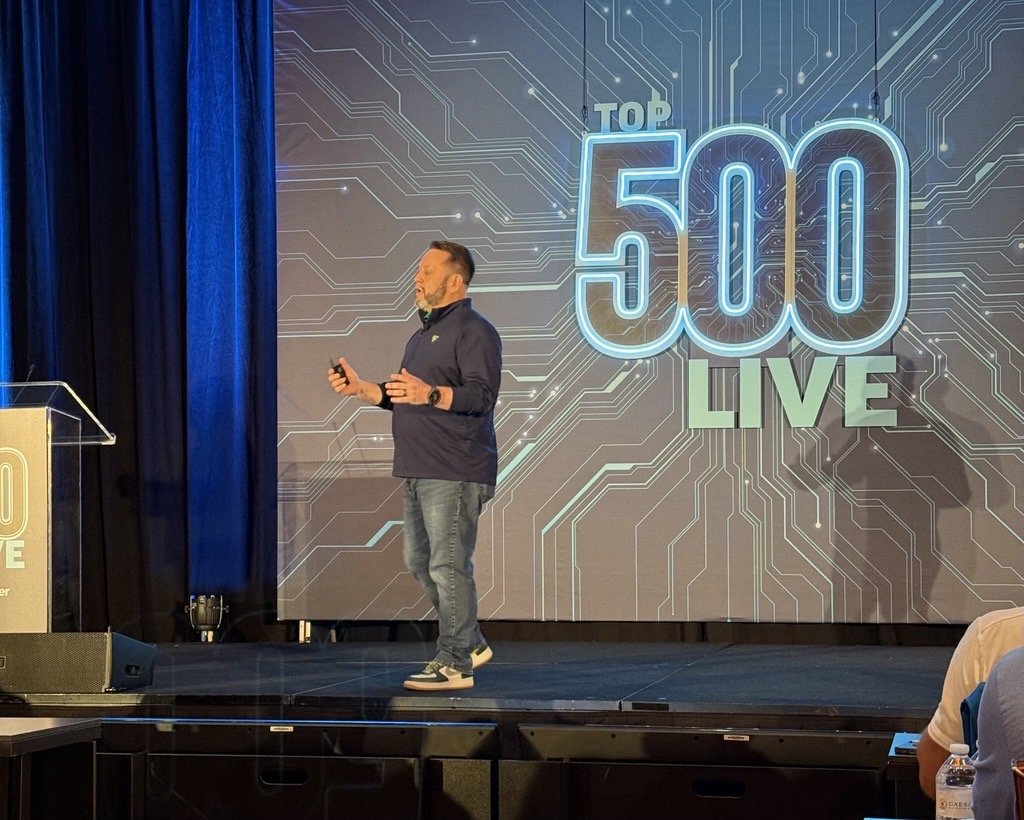
James Freeman, CEO of PJ Fitzpatrick, sharing how the company invests in continuous learning and career development to help its people grow alongside the business.
Growth puts pressure on the operating system
Several leaders described how processes that work well in one location can become harder to manage as a company expands across markets, products, and teams.
Power Home Remodeling shared how it built an integrated technology ecosystem across sales, scheduling, installation, employee communication, and customer updates. Home Genius Exteriors described taking an incremental approach to growth: improve what is already working while adding capabilities that can support the next stage.
Leaf Home’s discussion of combining with Erie Home added another dimension. A larger footprint creates opportunity, but it also brings the work of aligning teams and processes while staying responsive to local markets.
The common thread was that growth is not just a matter of adding locations or increasing lead volume. The business needs the people, tools, and routines to deliver consistently as it gets more complex.
The customer experience is built across the whole journey
Many of the sessions connected marketing results to what happens after a lead comes in. How quickly the company responds, whether the appointment is convenient, how clearly the proposal is presented, and whether installation matches expectations all influence the homeowner’s experience.
Marcus Sheridan spoke about homeowners’ desire for useful information earlier in the buying process. Examples included clearer pricing guidance, online estimates, scheduling options, and content that answers common questions. The CMO panel focused on measuring beyond cost per lead, with attention to contact rates, appointments, sales conversion, and completed work.
Other speakers emphasized the importance of follow-through after the sale. Power Home Remodeling’s customer app, for example, gives homeowners updates on their projects. Home Genius Exteriors described responding to customer questions and online reviews promptly, along with making personal gestures when a customer experience falls short.
These examples reinforced that the customer experience is shaped by the entire process, not a single interaction or department.
Technology is moving from experimentation to practical use
AI was a prominent topic, but the most grounded examples were tied to specific tasks. Power Home Remodeling described using it to summarize project notes, analyze calls for coaching and compliance, help managers access operating information, and follow up with job applicants. The CEO panel discussed AI for after-hours and overflow calls, with human support and quality checks still part of the process.
The useful distinction was between adopting technology because it is new and applying it where it can improve coverage, save time, or make information easier to use. The speakers who had moved furthest seemed to treat AI as an operating capability that needs to be monitored and improved, not a one-time installation.
Developing people remains central to scale
Technology and process received plenty of attention, but so did people. PJ Fitzpatrick’s James Freeman described PJ University as a continuous learning system that includes onboarding, role-specific training, ongoing education, leadership development, and career paths.
The idea behind it was straightforward: employees are more likely to grow with a company when they can see how to build skills and take on new responsibilities. Several CEOs also spoke about developing leaders internally and preparing teams for expansion before growth creates gaps.
Familiar ideas, useful examples
None of these themes was revolutionary. What I appreciated was hearing leaders explain how they are putting them into practice, where they are investing, and what they have learned as their companies have grown.
For me, that was the value of QR Top 500: a chance to compare notes with people across the industry, reconnect with familiar faces, and leave with a clearer view of the work behind sustainable growth.